

 Image 1 of 1
Riichi Mahjong 101 covers all the essential knowledge and skills a beginner needs to start playing Japanese-style Mahjong. Because this introductory class focuses purely on gameplay basics without complex scoring or points, it shares a very similar foundation with the Hong Kong style.
If you already have experience playing Hong Kong Mahjong, I recommend skipping ahead to my 102 class.
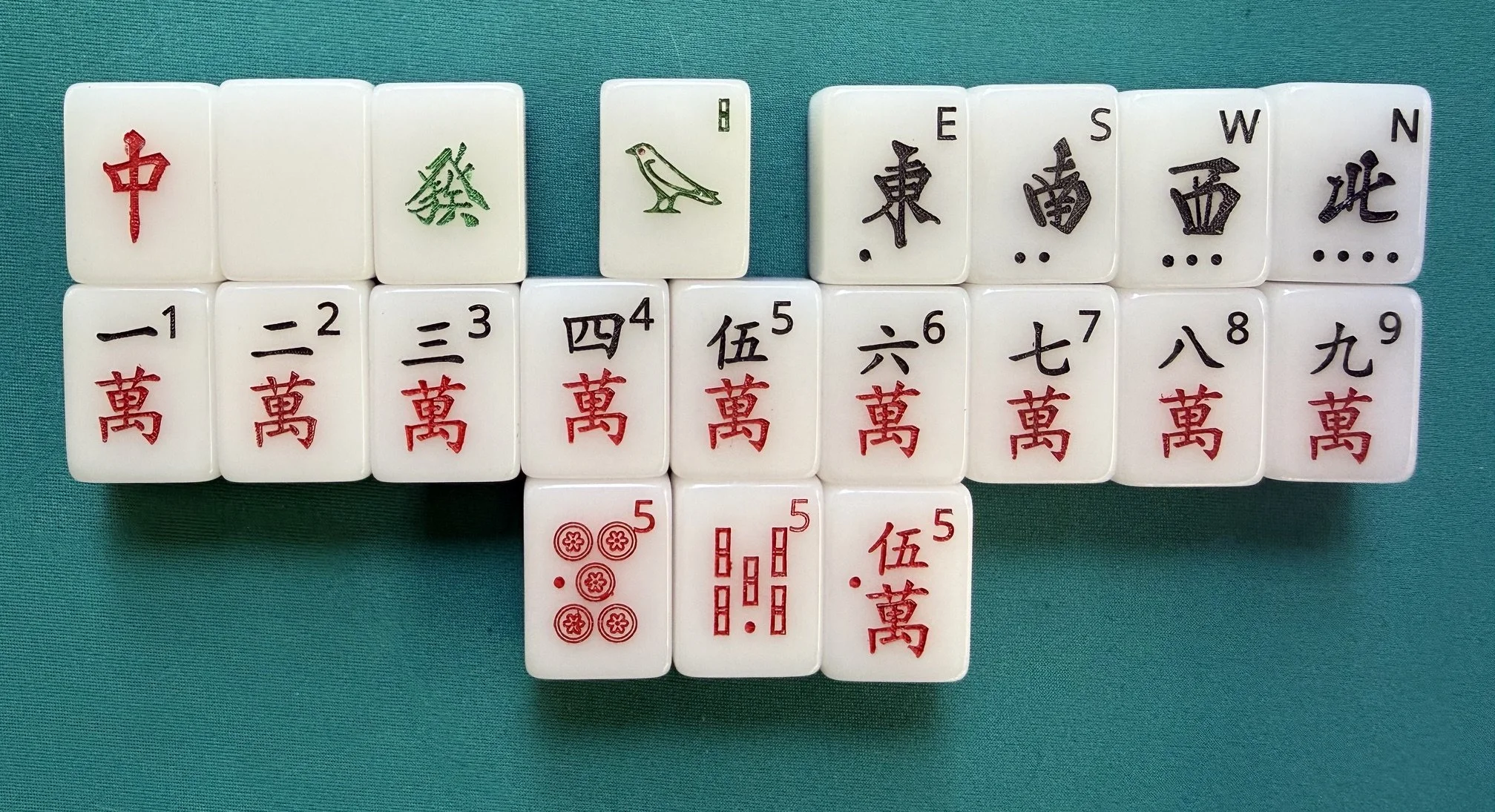
To simplify the learning curve, we'll use the pictured learner tiles, which explicitly identify each character and wind.
All materials needed to play Riichi Mahjong are provided at this class.
I will also provide a water bottle and packaged snack for each attendee along with some laminated learner sheets.
What you’ll learn:
Tile set and notation
Names, suits, and special tiles: man (characters), pin (dots), sou (bamboo), winds, dragons, and dora indicators.
Game setup and flow
How to set up the walls and dead wall.
Dealer rotation and basic turn order.
Drawing, discarding, and the end conditions for rounds.
Making hands
The concept of melds (chi, pon, kan).
Fundamental calls and melds
How and when to call chi, pon, and kan.
By the end of Riichi Mahjong 101 you will be able to identify tiles, understand game flow, build and evaluate simple ( 4 sets of 3 and a pair) hands, and make basic calls. You’ll have the foundation to play casual games and can continue with 102 to learn basic scoring and when to open your hand.